Pressure cook

A speculative interactive installation exploring social cooking and teamwork under technological control. Participants cook together while the system rotates tasks, monitors counter cleanliness, and prompts interaction and intentionally creates pressure. The project highlights how technology mediates collaboration, revealing how systems that claim to improve teamwork can induce stress, mechanical behaviour and self-awareness.
Overview
Cooking together can be both a bonding experience and a source of conflict. Differences in habits, styles, and cultural backgrounds often create tension, uneven participation, and misunderstandings in shared kitchens. Current approaches to addressing social challenges like this often rely on technology but such solutions don’t always produce the desired results and can sometimes make collaboration feel forced or mechanical.
Tools & Standards: Arduino, VS Code, Miro, Figma, User Testing
initial Research Insights
The team's selected domain was social cooking. To understand the problems faced in this domain, we conducted a literature review and 10+ interviews. Using thematic analysis, we identified key issues that users faced
- The social part is not the issue, things mostly fall apart due to issues related to collaboration
- People want to distribute tasks equally and not have to do both cooking and cleaning
- Some people are too inexperienced and are shy to take initiative incase they make mistakes
- Some people genuinely do not enjoy cooking and do not want to cook
- Experienced cooks find that others are too messy and do not enjoy working with them
- People have different ways of cooking or different recipes but do not want to compromise but force themselves to compromise to move on
The Ask
Cooking together can be both a bonding experience and a source of conflict. Differences in habits, styles, and cultural backgrounds often create tension, uneven participation, and misunderstandings in shared kitchens. Current approaches to addressing social challenges like this often rely on technology but such solutions don’t always produce the desired results and can sometimes make collaboration feel forced or mechanical.
The Design
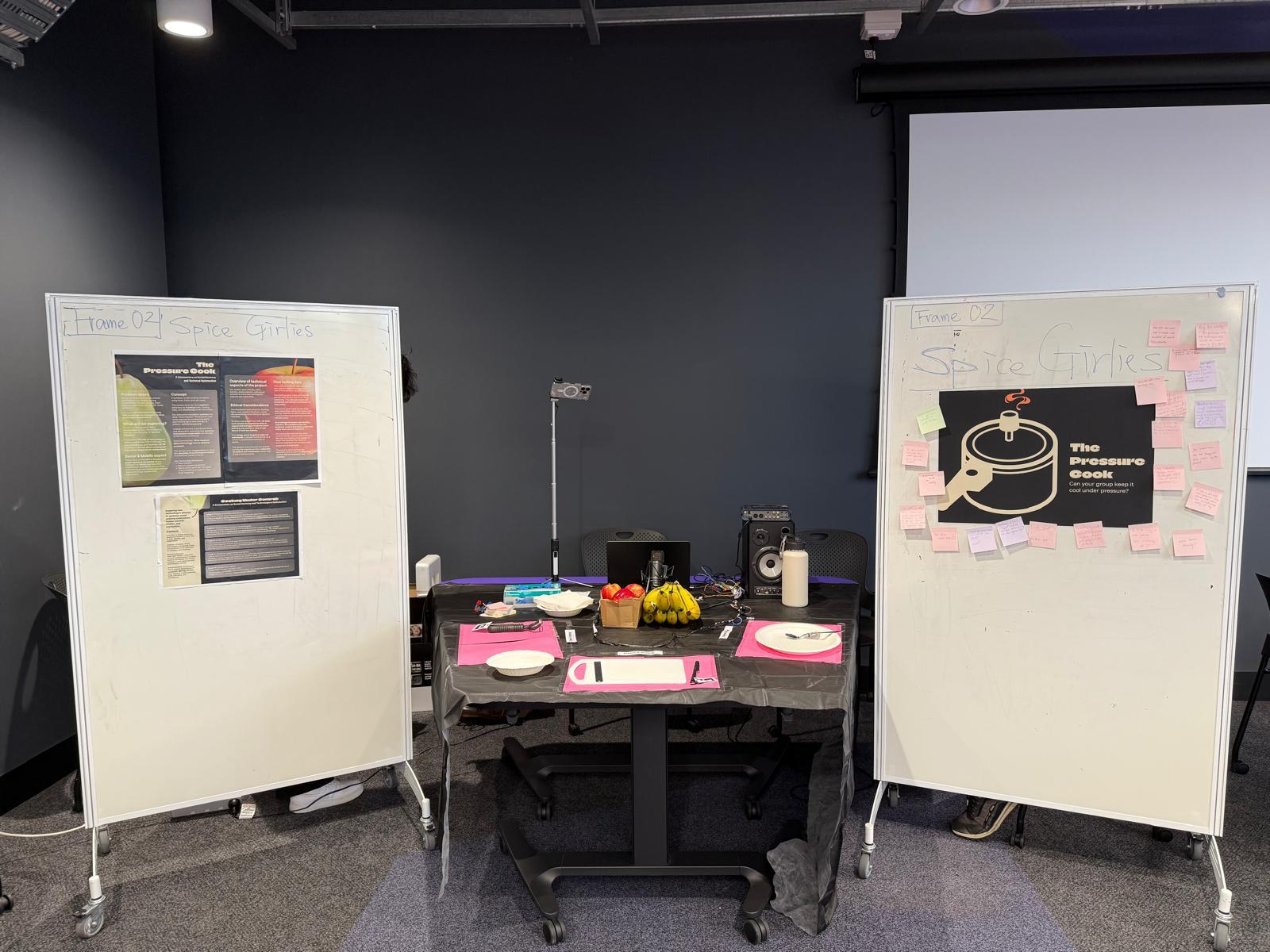
The Pressure Cook demonstrates how and why technology can both mediate and complicate social interaction. By rotating tasks, monitoring cleanliness, and prompting social behaviour, the installation exaggerates technological control to provoke reflection on teamwork, cooperation, and how digital systems shape human behaviour.

User Testing & Development
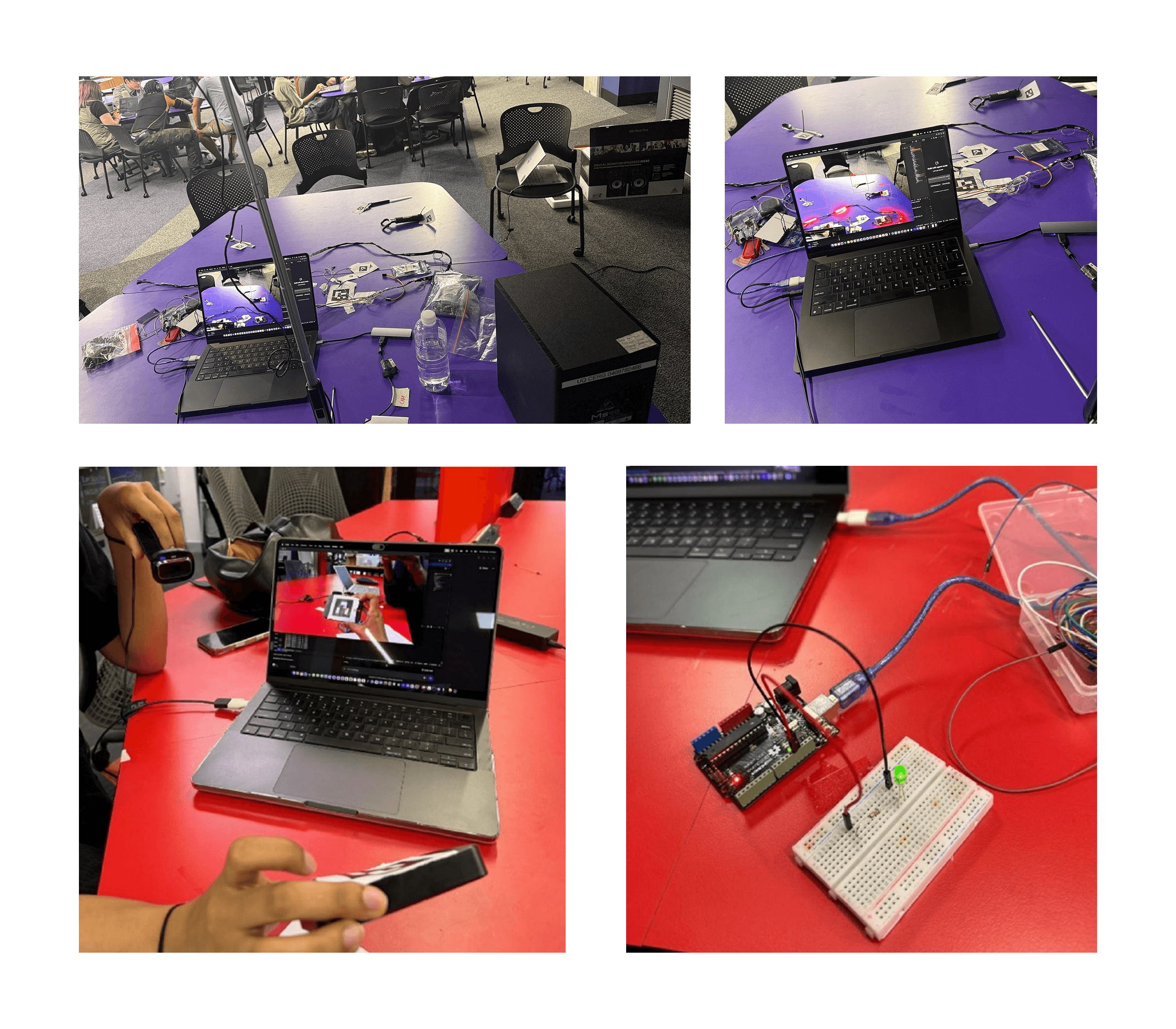
The project evolved through research, ideation, prototyping, and iterative testing. Early paper prototypes confirmed that the system successfully created a sense of pressure and uncertainty, which aligned with our goal. However, participants didn’t have enough time to complete meaningful portions of their tasks before rotations occurred, so we adjusted timing, recipe visibility, and prompt clarity. The physical system was then built using Arduino, LEDs, ArUco markers, and sound sensors to rotate tasks, monitor cleanliness, and track social interaction. Iterations focused on balancing playful tension with clarity, ensuring participants could engage meaningfully while experiencing the intended social “pressure.”
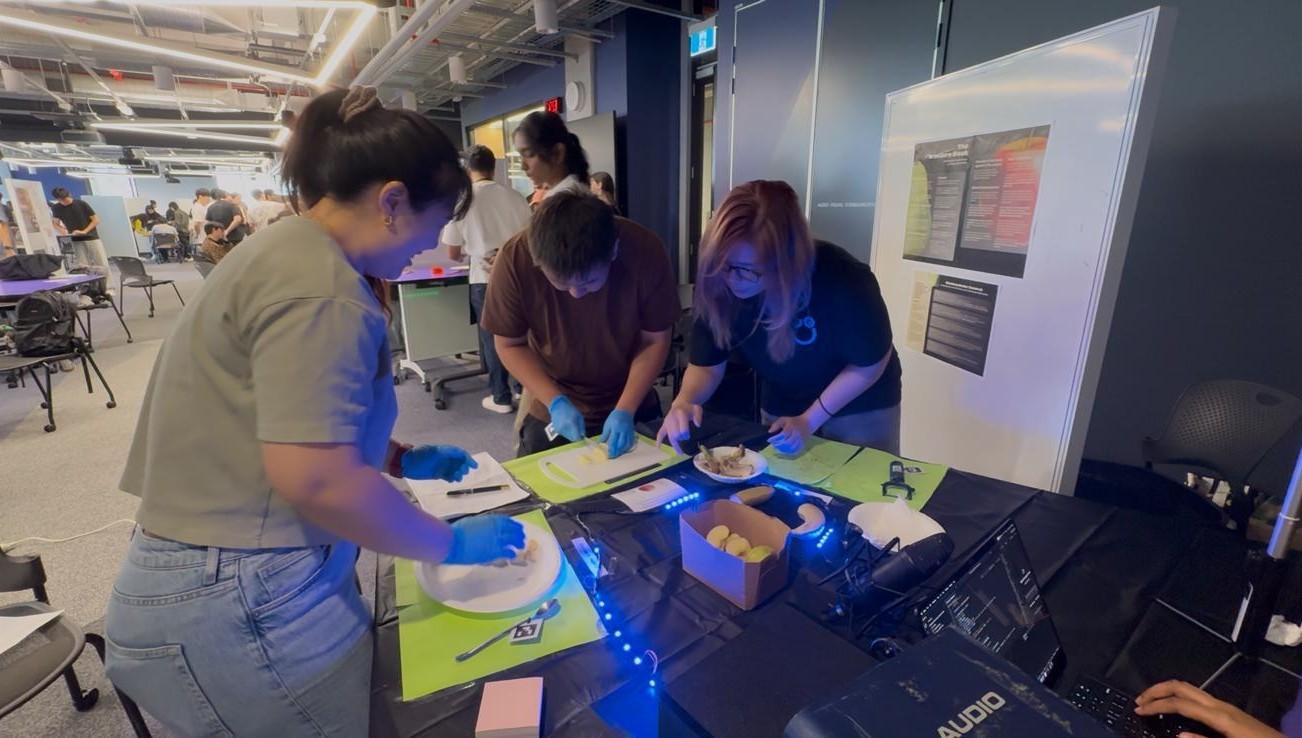
TRADESHOW DEMONSTRATION WITH PARTICIPANTS
the takeaway
The Pressure Cook illustrates how technology can mediate but also complicate social collaboration. The installation highlights the tension between automation and human behaviour, showing that enforcing fairness or cooperation digitally can create stress and mechanical participation. The project encourages reflection on how technology influences relationships, teamwork, and emotional dynamics, and demonstrates that discomfort can be a powerful tool for insight.
Overview
Cooking together can be both a bonding experience and a source of conflict. Differences in habits, styles, and cultural backgrounds often create tension, uneven participation, and misunderstandings in shared kitchens. Current approaches to addressing social challenges like this often rely on technology but such solutions don’t always produce the desired results and can sometimes make collaboration feel forced or mechanical.
Tools & Standards: Arduino, VS Code, Miro, Figma, User Testing
initial Research Insights
The team's selected domain was social cooking. To understand the problems faced in this domain, we conducted a literature review and 10+ interviews. Using thematic analysis, we identified key issues that users faced
- The social part is not the issue, things mostly fall apart due to issues related to collaboration
- People want to distribute tasks equally and not have to do both cooking and cleaning
- Some people are too inexperienced and are shy to take initiative incase they make mistakes
- Some people genuinely do not enjoy cooking and do not want to cook
- Experienced cooks find that others are too messy and do not enjoy working with them
- People have different ways of cooking or different recipes but do not want to compromise but force themselves to compromise to move on
The Ask
Cooking together can be both a bonding experience and a source of conflict. Differences in habits, styles, and cultural backgrounds often create tension, uneven participation, and misunderstandings in shared kitchens. Current approaches to addressing social challenges like this often rely on technology but such solutions don’t always produce the desired results and can sometimes make collaboration feel forced or mechanical.
The Design
The Pressure Cook demonstrates how and why technology can both mediate and complicate social interaction. By rotating tasks, monitoring cleanliness, and prompting social behaviour, the installation exaggerates technological control to provoke reflection on teamwork, cooperation, and how digital systems shape human behaviour.
User Testing & Development
The project evolved through research, ideation, prototyping, and iterative testing. Early paper prototypes confirmed that the system successfully created a sense of pressure and uncertainty, which aligned with our goal. However, participants didn’t have enough time to complete meaningful portions of their tasks before rotations occurred, so we adjusted timing, recipe visibility, and prompt clarity. The physical system was then built using Arduino, LEDs, ArUco markers, and sound sensors to rotate tasks, monitor cleanliness, and track social interaction. Iterations focused on balancing playful tension with clarity, ensuring participants could engage meaningfully while experiencing the intended social “pressure.”
TRADESHOW DEMONSTRATION WITH PARTICIPANTS
the takeaway
The Pressure Cook illustrates how technology can mediate but also complicate social collaboration. The installation highlights the tension between automation and human behaviour, showing that enforcing fairness or cooperation digitally can create stress and mechanical participation. The project encourages reflection on how technology influences relationships, teamwork, and emotional dynamics, and demonstrates that discomfort can be a powerful tool for insight.
NEXT PROJECT
PSP Portal
UI/UX Design & Research
Pressure cook
A speculative interactive installation exploring social cooking and teamwork under technological control. Participants cook together while the system rotates tasks, monitors counter cleanliness, and prompts interaction and intentionally creates pressure. The project highlights how technology mediates collaboration, revealing how systems that claim to improve teamwork can induce stress, mechanical behaviour and self-awareness.